Wednesday, August 12, 2009

The biggest fake charity of them all?

Who do you think this might be?

Government funding comes in the form of Parliamentary Grants-in-aid which, over the last four years (most recent accounts 31st March 2008), has amounted to: £31.7m, £32.9m, £36.6m and £44.9m respectively. So from 2005 to 2008 the government’s contributions have increased by about 42%.

The next heading in the accounts is ‘Other grants and contributions’, which suggests more support from the public sector. For the same period this amounts to: £9.5m, £8.8m, £7.3m and £7.8m. It looks as though, you can add about another £8m (on average) in public funding to the amount received from Parliamentary Grants-in-aid.

Turning to the expenditure side of the accounts, we find that items that are attributable to research funding amount to £29.0m, £30.2m £32.3m and £38.4, an increase of 32% over four years. So the Society’s activities as a conduit for government funds directed towards research have also increased at the same time as the Parliamentary Grants-in-aid, but to a lesser extent.

But it is some other items of expenditure that really caught my eye.
2005 Informing scientific policy £0.4m
2006 Independent advice nationally and internationally £1.1m
2007 Influence policymaking with the best scientific advice £1.5m
2008 Influence policymaking with the best scientific advice £2.3m
This area of expenditure has increased by nearly six times.

Although the wording in these entries varies, it is pretty clear that they all cover the same activities, and the latter two entries are quite unambiguous. Moreover they look very much like allocations for lobbying activities directed towards the government, which in turn funds the Society.
One clue: It's sometimes described as an "august" body or institution.

Go on, have a guess before clicking through to find the answer.


Via Benny Peiser.

Did you mean...?

If you type "recursion" into Google, it asks, "Did you mean: recursion."
John Rentoul.

Never a truer word spoken

'I am kindly and old. But I am not harmless'
Tony Benn

Thursday, August 06, 2009

Farewell, Sam

Very sad:

Sam, the Australian koala who became an international symbol of hope in the aftermath of the “Black Saturday” bushfires earlier this year, has died in Melbourne.
[...]
David Tree, the Country Fire Authority volunteer who was photographed giving the exhausted Sam a drink of water, agreed a vaccine needs to be found to help the animals fight the disease [Urogenital Chlamydiosis].

"It's like not worth it now, that she managed to survive the fires but die from a disease that they should be able to vaccinate her against," Mr Tree told Melbourne’s Herald Sun newspaper.

"I'm sobbing like a baby and I am a grown man. She meant so much - she highlighted the plight and vulnerability of Australian wildlife around the world.''

Graun

This is a good one, even by the high standards of The Guardian:

This article was amended on 28 July 2009. Due to editing changes, the original said that the dragonfly family "has more species than any other mammal". This has been corrected.

Tuesday, August 04, 2009

Helicopters

In Afghanistan:

The war is serious here; earlier in the day, another soldier from 2 Rifles had been killed upriver at Kajaki. Though morale in the U.K. seems to be slipping, I see no evidence of low morale among the soldiers, though there are increasing grumbles that they don’t get mail from loved ones due to helicopter shortages. Helicopters are one of our great advantages against myriad disadvantages, yet our combat forces are shortchanged by penny-wise, pound-foolish governments. The helicopter shortages are adversely affecting our op tempo.
Michael Yon on the ground with British troops.

An inspiration to us all


Jack Nicholson, at 72.

(Thanks, Kes, for the swimming pic)

Rapid evolution

Interesting 15 minute talk here from Professor David Skelly. His study of the Cane Toad in Australia suggests that very rapid evolutionary changes since its introduction as a foreign species in 1935 account for its unanticipated ability to spread to new forms of habitat.

He is now looking at how species might adapt to climate change in North America, comparing populations of tadpoles in warm and in cool ponds.


What struck me, though, is that while both AGW and the cane toad in Australia have a history of the same order of magnitude, some tens of decades, it has been possible to observe changes in the toad, introduced from South America, but not in species of amphibians living in North America.

Climate change, it appears, has yet to start happening - at least, if this is anything to go by.

Tim Blair noticed something similar.

Crisis

... recent evidence suggests that America's hard-working hometown legislators are feeling the pinch from a fickle and increasingly out-of-touch voter class who no longer serves our needs.
Iowahawk.

Sunday, August 02, 2009

Mill and the burka

In On Liberty, Mill argued that the only acceptable reason for interfering with the freedom of another person was to prevent harm, either in self defence or on behalf of a third party; interfering to prevent harm to the person whose freedom would be curtailed would not meet this condition.

In Utilitarianism, Mill argued that morality (and to some extent public policy) should be guided by the principle of bringing the greatest happiness to the greatest number of people.

On the face of it, those two ideas can conflict. Arguably, the case has to be made that they can be reconciled; how can any collective weighing of happiness influence a view of liberty that does not even acknowledge the collective?

You can reduce the frequency of conflict by assuming that people are good judges of what makes them happy, so a utilitarian outcome can be achieved by leaving them alone. This doesn't deal with issues like capital punishment; if there's a deterrent effect to be achieved by hanging someone who turns out to have been innocent, that might be the utilitarian outcome.

This might not be in conflict with the Liberty principle. If the deterrence saves the lives of third parties, haven't they been prevented from coming to harm? Mill believed that in cases of the most exceptional gravity, when evidence was conclusive, there should be a death penalty.

But did Mill progress from one idea to the other? Probably not. He was raised as a utilitarian. That's unusual, but so was his upbringing. He published On Liberty in 1859 and Utilitarianism in 1863. His speech in favour of capital punishment was delivered to the House of Commons in 1868. Either he suffered from an outbreak of liberalism in the late 1850s but reverted to utilitarianism, or he held both ideas at the same time.

While an attempt can be made (is made, above) to reconcile the principle from On Liberty with capital punishment, it's also possible to argue in the opposite direction, that a general good is not one of the two justifications for restricting the liberty of a person. The stronger argument for capital punishment comes from Utilitarianism. In a manner of speaking, for Mill at least, in this case utilitarianism trumps liberty. Is this a general rule?

Thought experiments might seem to suggest so. If a lifeboat can only hold seven, and there are eight people hanging on to it, and so it is sinking, should one person, however selected, be jettisoned so the others can live? Utilitarianism says they should and points out that the jettisoned person will drown either way, so it does them no (extra) harm.

If a city can be saved by handing over a hostage? Same argument.

But what if a terrorist can reveal the location of a ticking nuke in a major city, but only if tortured? This time it isn't so clear. That might be because it's a case we have had to consider recently, with the waterboarding scandal. And it seems that when actually faced with such an issue, the prevailing consensus has been the Liberty argument. It's widely agreed, though there are dissenters, that torture is never acceptable.

And would we really prise someone's fingers from the lifeboat and leave them to drown? Or give up a hostage to certain death? I have a feeling we wouldn't. We'd take it in turns to drag behind the boat on the end of a rope; we'd stall, the negotiator would offer himself as a hostage. Someone would make a noble gesture. We'd fight, perhaps, even against heavy odds. We'd take the liberty argument.

So is that a rule? Does liberty trump utilitarianism? Not always. We have abolished capital punishment, but the entire penal system is an exercise in utilitarianism. People were waterboarded, but this, it is widely agreed, was a moral wrong. Prisons, on the other hand, are generally accepted as necessary, even if they are necessary evils.

And perhaps there are some deeper, basic rules we know we should never break - not killing, not stealing - and these are inviolate. Perhaps throwing someone over the side would break one of these rules and it is this that prevents us from doing it, and not Mill's principle of liberty.

I can't see any general rules, or laws, that derive from these arguments, to be applied when individual rights conflict with the interests of groups of people. I think there might be things we regard as absolute wrongs and that these provide a baseline. Beyond that, when utilitarianism and liberty conflict, it has to be considered on a case by case basis - though we have some measures to lay the problem against. How does it affect liberty? How is the general well-being affected? Those are good measurements to take.

Norman Geras disagreed with Oliver Kamm about the banning of the burka, and in the course of doing so wrote the following:

[Kamm] needs to show, adducing evidence which is compelling, that women who wear the burka do so under duress, or at least that the great majority of them do. Even then, he has further to meet the point that the most natural response to the problem by way of policy would be to place a legal prohibition on the duress - on the coercion of women to wear what they would rather not. After all, if there are some or many women whose own choice it is to wear the burka, a legal ban on their doing so does not uphold their equal citizenship
This is a clear case of conflict between the rights of individuals to wear a burka, and the rights of (a group of) other women not to be coerced and forced into a second-class status, or worse. But I don't think Norm was right to say there should be a majority of coerced burka wearers. At least, not correct when Mill's measures are used. This is a question not of the greatest number of people, but of the greatest harm.

Is a greater harm done by coercing a woman into an inferior role than by banning a mode of dress? Is it really one for one, onto the scales, or does a form of slavery, at the worst, matter more than the prohibition of an extreme form of costume? I think it must. That's not to say the harm done to the individual who wants to wear a burka is insignificant. It isn't, but it is less than that done to the coerced woman.

How widespread is this sort of coercion in Europe? I have no idea. Not a clue. I don't think anyone does. How would you even gather the information on which to base an estimate? Let's just say some are. In other places, parts of Pakistan and Afghanistan, for example, we know it's a characteristic of the society, allied to other things like the throwing of acid into the faces of girls who go to school.

If this harm elsewhere is linked to the burka wearing on our streets, then the weight of harm from the latter becomes far greater. Can that link be made? I think it can in at least this way: it can only impede attempts at reform in those places if the cultural practices that need to be reformed are spreading into Europe. The forced subjugation of women should be an ebb tide, not a rising one.

In what way is it more acceptable to have women prevented by law from working if they choose to, from wearing the clothes they want, from going out unaccompanied by a man, to be refused an education than to have the sort of race apartheid that was so unacceptable internationally in the past?

In the list immediately above is "wearing the clothes they want". This cuts both ways. Individual rights are affected whether you ban the burka or not - those of the voluntary wearers if you ban it, of the coerced ones if you don't. But the wider group interest, the moral weight of the other things that accompany this coercion, the entire second-class status, on the one hand has no counterweight on the other.

What if apartheid South Africa not just still existed, but there were advocates of apartheid in European countries loudly proclaiming that apartheid was the way forward, the future of man? What if many of them came from South Africa and had brought black South Africans with them, and maintained them in a second-class status, obliging them to wear striped trousers with frayed bottoms, held up with rope, and to go barefoot? What if some of the black Africans also thought apartheid was the way forward, and chose to dress like that?

Where's the cultural opposition to sexual apartheid, the way there was with South African apartheid? Of course it comes mainly from the left, this sort of cultural opposition, and the left is crippled by splits over just this sort of issue.

There's an argument that, working from practical considerations as well as the principle that everyone should be treated the same, wouldn't let anyone in a burka anywhere someone in a ski mask would be challenged or refused entry, like a bank, or a jeweler's shop, or passport control. Or a school or a hospital. This is a secular argument, it refuses to make exceptions on religious grounds. It's also rejects cultural relativism, refusing to make exceptions on cultural grounds. I think it's right.

So some restrictions on the places where a burka can be worn is reasonable. How about a ban? There's a tactical argument. Maybe banning burkas or stripey trousers with frayed ends isn't the right way to bring the problem to an end as fast as possible. I don't think arresting women for wearing burkas would help. But a formal ban on them being worn to schools (I'm using the word burka to include any religious dress that covers the face)? Yes, that's reasonable and flows from the ski mask test - ski masks would also be rejected by schools.

I'd summarise the arguments as follows:

  • The burka can't be banned because we can't have the police arresting someone for their clothing, except where there's a clear danger of a breach of the peace (a Klansman in Harlem, perhaps). That's for practical reasons, but also on utilitarian grounds: greater general happiness would probably exist in a society in which the police aren't dragging screaming women into vans, than in one in which they are.

  • Practical reasons aside, the burka should be banned. The rights to wear and not to have to wear particular clothing balance out. But the burka is a part of a system of oppression that has no counterweight in the equation. The rights of the voluntary burka wearer are out-weighed; the burka should be banned.

  • The practical difficulties mean the burka should not be banned.

  • We shouldn't make special exceptions for the burka, so it should be treated like any other mask. That is, we should all be equal under the law. Equality of treatment is implicit in Mill's idea of personal liberty. Making exceptions generates widespread disaffection and makes only a few happier, so it also fails on utilitarian grounds.

  • The case against sexual apartheid is overwhelming; the practical struggle against it is not helped by European countries adjusting to accommodate it.

Saturday, August 01, 2009

On balance

This is more of a feature than a bug:

The latest crime-fighting gadget, a cigar-sized camera attached to a police helmet, has gone up in smoke after problems with its batteries setting* on fire.


*Isn't that rather tortured syntax? "Batteries setting on fire"? Setting what on fire?

UPDATE: I wish my grammar was better. What is that? A reflexive use of the present participle?

Famous first lines

Aldous Huxley taught Eric Blair (George Orwell) at Eton. It's a fair chance that, just as Huxley was affected by 1984, so Orwell was affected by Brave New World. It's noticeable that both use the same technique in the opening sentence.

Brave New World:

A squat grey building of only thirty-four stories.

1984:
It was a bright cold day in April, and the clocks were striking thirteen.


"Only" 34 stories... clocks striking 13... we are not in our normal world.


Brave New World
was published first.

Friday, July 31, 2009

It would have sucked mightily

The black spot is huge, nearly 10,000 kilometers across, making it roughly the size of the Earth. It’s composed of dust, basically vaporized whatever-it-was-that-smacked-into-Jupiter. Probably an asteroid; a comet would’ve been spotted before the impact (because they are brighter), and no one saw it. The impactor itself was probably several hundred meters across, and the explosive energy release (in non-sciencey speak, the gigantic kaboom) would’ve been measured in the tens of thousands of megatons. Given that the largest nuclear weapon ever detonated on Earth was about 50 megatons, you may start to grasp the horrifying power of this event. Had it happened here, well. It wouldn’t be a global extinction event, not quite, but it would’ve sucked mightily.
The Bad Astronomy blog, on the recent impact on Jupiter.

Thursday, July 30, 2009

Website disclaimers

A memo for bloggers:

In the first case of its kind, the Court of Appeal has endorsed website disclaimers. Mistakes can be excused by warning notices, it ruled. However, the judges based their decision, at least in part, on a misunderstanding of how people use websites.

The case confirms that a website can owe a duty of care to its visitors. That much was predictable, albeit untested (by my recollection) in UK courts. What was less predictable was how easily a site could dodge that duty: simply tell your visitors to seek further information before they rely on what they read and, hey presto, you're off the hook. This month’s ruling is a gift for the risk-averse. Cue more disclaimers on websites.

The Great Repeal Bill

There used to be an informal grouping called The Repeal Club, back in the early 1980s, of peers in the House of Lords dedicated to, well, repealing unnecessary and destructive legislation. Douglas Carswell is now trying an experiment in Open Source politics:

Britain is over regulated. Laws, regulation and red tape stifle individuals, infantilise communities and strangle enterprise. We need a Great Repeal Bill.

Bills are traditionally drafted by "experts" and professional politicians. But it will require the wisdom and experience of all those struggling to cope with them to know which ones to scrap. That's why the Great Repeal Bill is not being drafted by them - but by you.
Find it here.

Edith Rigby

... anyone who chose to attack a Labour MP with a black pudding deserves some notice
That they do. A personal list of 5 English radicals from Edward Vallance.

Friday, July 24, 2009

Our coloured brethren

Norm is, of course, right:

Criminalize certain forms of mere speech, and newly offensive discursive tropes - euphemistic, oblique, metonymic - will find their way into the world as a replacement.

School choice

These sentences, from a piece by Neal Lawson, have been the subject of some debate:

Markets, the mechanism of choice, are designed to allocate the spoils to the winner. That's OK with supermarkets and car makers – it's not OK for the state. We can't have and can't allow schools and hospitals to fail and be replaced by the fittest.
Elsewhere in the piece, Lawson writes:
In essence, markets allocate resources on the basis of matching willing buyers to willing sellers.
That's almost right, whereas his apparent definition in the first quote, that markets are "the mechanism of choice" is not. Choice has many mechanisms. In fact, there's a lot wrong with the first quote. Markets haven't been designed to do anything at all; they simply haven't been designed. They're what we call the process of exchange. In what way are the cabbages on a market stall "spoils"? When we can all go and buy one of the cabbages if we wish, who are the winners and who the losers? In the context of education, where there is no market, the losers are easy to discern; they are the kids who are herded into the schools Lawson insists stay open, even though they are failing.

Lawson then suggests this mechanism is OK for staying alive (eating) and transport (though whether he sticks to that view when discussing transport policy might be another matter), but not for schools. Why not? He doesn't say, the first word of the next sentence is "Second" - he starts another point.

To suggest that it would be wrong for failing schools and hospitals to be replaced by fit ones is just... incredible. No, it's immoral. It amounts to the demand that people die avoidably, and have their life chances blighted, avoidably, in deference to his political dogma. And he even uses the words "fittest" and "fail", this isn't an exaggeration on my part.

The whole piece is like this, though. For some comment from the rational left we have to turn elsewhere. Chris Dillow suggests that for a market in education to succeed, schools have to be scalable. Why? A failing school would present, in a market, several opportunities - scaling is one of them for other schools, but there's also takeover and the opening of new competitive ventures. In a market, with lags and imperfections for sure, all of these things would happen.

The last decade has proved that state provisioning of education is prone to all the problems of, well, state provisioning. Apparatchiks send their kids to elite schools, the affluent and connected use their connections to remain affluent, inequalities increase, quality falls, tractor production rises to historic new heights.

This isn't entirely how I'd do things, but here's a suggestion for the non-authoritarian, anti-managerialist left: ban all parental input to school costs. No parents can pay school fees. But all children have vouchers and parents can send their kids where they want. Bad schools can fail, and the kids of parents who don't care as well as of those who do will have to go to better ones. Let people lift the quality up, rather the state drag it down.

Instead of parents trying to move to areas where there are good schools, pushing up property prices, creating new inequalities, there would be incentives for successful schools to open in areas where there are none at the moment. Mountains would start moving towards Mohammed.

How would the right cope with that suggestion? Any objections would be impossible to disguise as anything other than a wish to preserve hereditary privilege. As things stand, the imbecility of people like Lawson, demanding, explicitly, that failing schools be allowed to continue to fail - and in practice that means failing the most disadvantaged kids - masks all other considerations.

Thursday, July 23, 2009

Strange voyage

I started reading The Strange Last Voyage of Donald Crowhurst last night, a book I bought ages ago in a second-hand bookshop, mainly because it was co-authored by Nicholas Tomalin, one of the best journalists of the late twentieth century, a man killed tragically early while reporting from Golan in 1973, and one who deserves immortality if only for his observation "The only qualities essential for real success in journalism are ratlike cunning, a plausible manner and a little literary ability".

To be lazy, and quote Wikipedia's introduction:

Donald Crowhurst (1932–1969) was a British businessman and amateur sailor who died while competing in the Sunday Times Golden Globe Race, a single-handed, round-the-world yacht race. Crowhurst had entered the race in hopes of winning a cash prize from the Sunday Times to aid his failing business. Instead, he encountered difficulty early in the voyage, and secretly abandoned the race while reporting false positions, in an attempt to appear to complete a circumnavigation without actually circling the world. Evidence found after his disappearance indicates that this attempt ended in insanity and suicide.
What a story lies behind that brief description. Crowhurst set sail knowing he had no chance of success; he spent the night before departure lying in his wife's arms, weeping. She now thinks he was trying to get permission from her to abandon the voyage, at the time she thought he wanted encouragement.

Cropwhurst sailed in a trimaran, very fast, hopeless with a contrary wind, and impossible to right if it capsized. His strange mixture of genius, ambition and unpreparedness might be best symbolised by a device he invented to prevent the boat capsizing completely if overturned by a wave. A large inflatable bag was attached to the top of the main mast, connected by a wiring loom to a computer of his own design, in the cabin. This computer would sense that the vessel had gone over, the inflatable bag would float and hold the trimaran on its side, the computer would then adjust the buoyancy of the lower float until it sank enough for a wave to nudge the yacht back upright. Except that when he sailed, the bag was uninflatable, the wiring loom in place but unconnected at either end, and the computer was a storage compartment full of boxes of electronic components, all entirely unassembled.

The story of this man, who set out with no intention to deceive but descended into insanity and suicide, has been the subject of a dozen books, songs, films and plays. Why? I can offer three suggestions.

It's just a gripping story, there's an inevitability of doom from the very start, one that Crowhurst himself seems to have been aware of. Whatever his faults might have been, they didn't include cowardice. He set sail in a boat he knew was likely to kill him, one way or another. Whatever his deceits, they were unplanned and incremental, rooted in self-deceit, one leading to another, until he sat in his cabin, unhinged by Lear-like despair and isolation, surrounded by trailing wires and useless gadgets: the rubble of his life.

The story gives in miniature what could be a jaundiced view of the lives of many people, hopes and ambitions that descend into failure and self-deceit, though normally all of these elements exist on a far tinier scale than they did for Crowhurst.

And there's a little of Crowhurst in us all. Most of us learn to suppress and control the small inner child who sees an astronaut and wants to become one. Crowhurst never did.

Crowhurst left behind a wife, Clare, and four young children. In the introduction to the book, the authors say that while there is no hero in the story, there is a heroine, Clare Crowhurst. What must it have been like for her, discovering the truth about her husband's doom in the depth of her bereavement, faced with the prospect of raising four children alone?

Yet while "hero" might be too strong a word, there is, in this story, at the end, at the least a very fine man. Robin Knox Johnstone, who won the race Crowhurst was competing in and by doing so became the first man to sail single-handed around the world without stopping, donated his prize money to Clare Crowhurst:
“I never expected to win that money so it just made sense to donate it to a family who really needed it,” Knox-Johnston says from Fremantle. “I found out soon after what Donald had done. I was one of only half a dozen people who knew the truth but I didn’t feel bitter or betrayed, just terribly sad.”

Wednesday, July 22, 2009

What if it arrived pre-trained... ?

Babes of the BNP, revisited.

Humane human sacrifice

Human sacrifice is clearly a potent forcing agent in climate equilibration. Furthermore, analysis of the climate record suggests its decline has been a key driver of rising global temperatures. The Aztec (and other) priests were right. Only sacrifice will ensure humankind’s survival.

Given this outcome, should there not be an independent review of the United Nations Intergovernmental Panel on Climate Change (IPCC) perspective? Are atmospheric carbon dioxide increases really the dominant forcing agent for global warming (IPCC, 2007, p. 136), with the main contributor to human carbon dioxide emissions being fossil fuel combustion (IPCC, 2007, p. 512)? The review should assess whether other factors, such as global population growth, are important contributors to global warming.

Opposition to human sacrifice as a climate change mitigation strategy is possible. However, society is on the cusp of a paradigm shift. Excessive individualism is in decline. Neo-liberalism is under attack. There is growing recognition our fate is determined by mysterious events related to the Sun (Sol)—333,000 times more massive than Earth and just eight light-minutes away. The Age of Sol is dawning.

The eco-spirituality that led to the first Earth Day celebration in Stockholm on April 22, 1970, fortunately has deepened over the past three decades or so. Voluntary sacrifice is no longer seen as the macabre ritual of a barbaric culture. It is more dignified than it was 500 years ago too, due to advances in psychotherapy and therapeutic medicine. There is a place for it in Sol’s pantheon. After all: “Greater love hath no man than this, that he lay down his life for his friends (and future generations). He shall gain everlasting life.”

The threat of climate change is real. A long period of dangerous solar irradiance is inevitable without decisive action. Humankind has angered Sol for too long. The precautionary principle justifies reviving (humane) human sacrifice (HHS). It would be a wise exercise in risk management. To be climate-change-ready, national and global mitigation strategies should include HSS commitments, based on national population growth projections.

In Australia, the government should offer generous grants to HHS dependants; issue free (securitised) sacrificial credits to working families; create a new Order of the Bleeding Heart; and restructure the now redundant carbon emissions trading scheme as the Human Pollution Reduction Scheme. These initiatives would send a strong message to the world—and to all Cihuacoatl sceptics and Huitzilopochtli deniers—that this country is serious about climate change.


Via.

Atefah Sahaaleh

The rape of female prisoners prior to their execution in Iran has been commented on recently, following the publication in the Jerusalem Post of an interview with one of the Basiji - the militia that was so deeply involved in the violent suppression of the recent demonstrations in Iran:

He said he had been a highly regarded member of the force, and had so "impressed my superiors" that, at 18, "I was given the 'honor' to temporarily marry young girls before they were sentenced to death."

In the Islamic Republic it is illegal to execute a young woman, regardless of her crime, if she is a virgin, he explained. Therefore a "wedding" ceremony is conducted the night before the execution: The young girl is forced to have sexual intercourse with a prison guard - essentially raped by her "husband."
Many of these young girls have been convicted of "crimes against chastity" or adultery, and are therefore not virgins - unless they were not guilty. No matter, anecdotal evidence, including this, suggests they are raped anyway.

It's worth remembering the case of Atefah Sahaaleh, a 16 year old girl who was hanged in 2004:
Her death sentence was imposed for "crimes against chastity".

The state-run newspaper accused her of adultery and described her as 22 years old.

But she was not married - and she was just 16.
[...]
Being stopped or arrested by the moral police is a fact of life for many Iranian teenagers.

Previously arrested for attending a party and being alone in a car with a boy, Atefah received her first sentence for "crimes against chastity" when she was just 13.

Although the exact nature of the crime is unknown, she spent a short time in prison and received 100 lashes.

When she returned to her home town, she told those close to her that lashes were not the only things she had to endure in prison. She described abuse by the moral police guards.

Soon after her release, Atefah became involved in an abusive relationship with a man three times her age.

Former revolutionary guard, 51-year-old Ali Darabi - a married man with children - raped her several times.
This young girl was raped by the moral police then repeatedly raped by an ex-revolutionary guard.
When Atefah realised her case was hopeless, she shouted back at the judge and threw off her veil in protest.

It was a fatal outburst.

She was sentenced to execution by hanging, while Darabi got just 95 lashes.

Shortly before the execution, but unbeknown to her family, documents that went to the Supreme Court of Appeal described Atefah as 22.

"Neither the judge nor even Atefah's court appointed lawyer did anything to find out her true age," says her father.

And a witness claims: "The judge just looked at her body, because of the developed physique... and declared her as 22."

Judge Haji Rezai took Atefah's documents to the Supreme Court himself.

And at six o'clock on the morning of her execution he put the noose around her neck, before she was hoisted on a crane to her death.
How did the judge get to look at this girl's "developed" body, if even removing a headscarf was intolerable immodesty? Wikipedia adds some also un-sourced detail that, if true, answers this question (emphasis added):
After the execution of Atefeh, Iranian media reported that Judge Rezai and several militia members including Captain Zabihi and Captain Molai were arrested by the Intelligence Ministry. Inside sources informed the media that in addition to the confession of his rape of Atefeh, Judge Rezai who served as judge, jury and executioner, also confessed to torturing her during interrogations to extract names of others she had relations with.


On a side note, I see my old friend Darius Guppy has written to The Independent in support of the regime responsible for this barbarity. That's precisely the side I would have expected him to take. I recently conducted a video interview with the former Manhattan detective who led in the case of his faked robbery, Ray Berke, and will post it here once the editing is finished. Ray makes it very clear that where my account of past events has been different from that of Guppy, my version was correct.

Encouragement

It seems that genocidal violence is bad for the economy:

So if you want to draw conclusions from the statistics, the inescapable conclusion is that Palestinian Arab terror is the major driver for a reduction in Palestinian Arab standards of living. Conversely, relatively peaceful periods show that the Palestinian Arab GDP steadily increases when they aren't as focused on killing Jews.

If Zogby wants to help his Palestinian Arab friends, he should be encouraging them to stop their obsession with violence.


Via Snoopy.

Pakistan is the problem

Pakistani officials have told the Obama administration that the Marines fighting the Taliban in southern Afghanistan will force militants across the border into Pakistan, with the potential to further inflame the troubled province of Baluchistan, according to Pakistani intelligence officials.

Pakistan does not have enough troops to deploy to Baluchistan to take on the Taliban without denuding its border with its archenemy, India, the officials said. Dialogue with the Taliban, not more fighting, is in Pakistan’s national interest, they said.

The Pakistani account made clear that even as the United States recommits troops and other resources to take on a growing Taliban threat, Pakistani officials still consider India their top priority and the Taliban militants a problem that can be negotiated. In the long term, the Taliban in Afghanistan may even remain potential allies for Pakistan, as they were in the past, once the United States leaves.
This in the week a Pakistani militant changed his plea to guilty of charges that included waging war on India, a man who was simply the latest Pakistani terrorist to attack Indian civilians - while no attack has taken place in the opposite direction.

Oh Lordy

This is a bit late, but I just noticed the Achewood strip that followed the death of Michael Jackson:

He was your Elvis, and when your Elvis dies, so does the private lie that someday you will be young once again, and feel at capricious intervals the weightlessness of a joy that is unchecked by the injuries of experience and failure.

The shape of things to come

Gene at Harry's Place just posted about the extraordinarily brave Cuban blogger Yoani Sánchez. I subscribe to her blog feed, but hadn't looked at it for a while.

This post made me realise how close a world of carbon (and energy) rationing would be to that of a repressive and dysfunctional state like Cuba:

A store on Neptune Street closed yesterday so they wouldn’t have to turn on the air conditioner after exceeding the strict plan of kilowatts consumed. In a five-star hotel they tell the tourists they’re repairing the air conditioner but in reality they turn it off so the meter won’t run so fast. In both places the employees breathe the hot stuffy air while few customers venture into the large market to buy, or remain in the lobby of the luxurious accommodation.
Ms Sánchez has a suggestion for other energy efficiencies:
Obviously these measures originated in some office air-conditioned by “up there”; they occurred to those who, at three in the afternoon, didn’t have to wait for a document in a place where more than twenty people were crowded together, sweating. I would like to throw out a proposal to the architects of this program, that they extend the cuts to certain untouchable sites where the thermometer still shows less than 25 degrees Celsius. It would be good, for example, to ask the members of the National Assembly, who are meeting on August 1st, to travel to their meeting on public transport so as not to waste fuel on their chartered bus. They should, keeping with the electrical restrictions we all live with, deliberate by the light of candles, drink warm soft drinks at the break, and limit their session to only a couple of hours, to avoid the costs of using the microphones and the TV transmitters. The unanimous approval and frantic applause which characterizes all their actions don’t require much meeting time, nor the enjoyment of relaxing air conditioning.

Tuesday, July 21, 2009

Kos and liberty


The Daily Kos has started its own version of Wikipedia, for politics. And it would be rude not to take a moment to make fun of its - acknowledged - biases.

However, classical liberals and libertarians might be interested in this piece by the man himself, from 2006. There's not much wrong with this:

A Libertarian Dem rejects government efforts to intrude in our bedrooms and churches. A Libertarian Dem rejects government "Big Brother" efforts, such as the NSA spying of tens of millions of Americans. A Libertarian Dem rejects efforts to strip away rights enumerated in the Bill of Rights -- from the First Amendment to the 10th. And yes, that includes the 2nd Amendment and the right to bear arms.
And he went on to cast a more realistic light on "positive" freedoms than is often the case:
A Libertarian Dem believes that true liberty requires freedom of movement -- we need roads and public transportation to give people freedom to travel wherever they might want. A Libertarian Dem believes that we should have the freedom to enjoy the outdoor without getting poisoned; that corporate polluters infringe on our rights and should be checked. A Libertarian Dem believes that people should have the freedom to make a living without being unduly exploited by employers. A Libertarian Dem understands that no one enjoys true liberty if they constantly fear for their lives, so strong crime and poverty prevention programs can create a safe environment for the pursuit of happiness. A Libertarian Dem gets that no one is truly free if they fear for their health, so social net programs are important to allow individuals to continue to live happily into their old age. Same with health care. And so on.
No rational right-libertarian denies the existence of negative externalities (though some irrational ones do), nor would they quibble about law and order. The sticking points are transport and health care.

Perhaps. These are similar arguments. Shopping has moved from High Street to supermarkets you really do need a car to use, especially in the country. Are you really free if you're unable to buy the food others can and don't have access to health care because you're uninsured? Yes, you can be. But here the liberal and the libertarian part company; concern for the less well off has always been a liberal preoccupation, since Adam Smith and Mill (in the latter case the utilitarian argument is obvious). On health care, the libertarian and the overwhelming majority of this country part company. Libertarians can choose to bathe in the streams of doctrinal purity if they wish, but they make themselves irrelevant if they do. It would be more fruitful to debate how tax-funded treatment should be provisioned - by the People's Army or private suppliers - than over whether it should exist.

It does strike me, though, that a significant alliance is not being formed - liberal people from right and left - because both prefer to let the best be the enemy of the good.

Sudden impact

Not sure why this hasn't made the front pages - a very large object seems to have hit Jupiter. And the impact was first spotted by an Australian amateur astronomer called Anthony Wesley. That's one of the things I like best about astronomy - at the moment it's still possible for the amateur to make discoveries.

Unclear

The following two paragraphs were published in the opposite order, originally:

It is unclear how the 36-year-old man, named by local media as Ronald Marshall, was set alight, but family members told the Australian newspaper that his body burst into flames after the Taser hit him on the bridge of his nose.
And:
The incident took place in the West Australian remote desert community of Warburton after police approached a house where the man and others were sniffing petrol...

Monday, July 13, 2009

A caristia of labourers

How much suffering can one short, forgotten phrase contain?

"Caristia" is a Latin word, but Caesar wouldn't have understood it. It came into use in English records during the Middle Ages, meaning a "dearth", or shortage. Manorial records sometimes refer to a caristia of labourers.

This phrase seems to have meant both fewer hands than were needed, and increased wages for those that could be found. Both prices and wages were fairly slow to change, in the long term, during the Middle Ages partly because they were often set in terms of long term contracts for tenancy or service, partly because there were strong, especially religious, conventions about the correct levels for prices and wages, and against arbitrage.

But you can't buck the market entirely. Short term price and wage fluctuations were inevitable. During the thirteenth and fourteenth centuries, for example, wheat prices rose gradually from under 3s a quarter to over 6s. But during the bad harvests of 1315-17 the price hit 25s.

That was an extreme case, the sudden onset of global cooling after the wealth and comfort of the Medieval Warm Period. But there would be shortages of labourers from time to time anyway, with the normal fluctuations of the years and their harvests. I have a very heavy crop of cherries this year in my garden. Last year there were almost none. When that happens with cherries in a developed economy, I go to the shop and buy some that were grown somewhere that had a better harvest this year - trade smooths out supply. When it happens with wheat in a peasant economy, people die. During the Middle Ages, some years so many men died that it affected the level of wages.

A moment's reflection on what the reality of this must have been like gave me my opening sentence.

Why did ordinary variations in production have a greater effect during the Middle Ages than they do today? The answers are surprisingly relevant to us now, and to the sorts of arguments put forward by what you might call the neo-primitivists - that odd assortment of people from the green left to the isolationist, protectionist and libertarian right who want to return us to a golden age of disease and starvation.

The problem they had, in the past, is that they didn't trade*, and they didn't try to make profits - they weren't capitalists. This killed, from time to time, sometimes two digit percentages of the populations unnecessarily.

Here's an odd thing: in a tenant-peasant economy, when farmers produce just enough to feed themselves and to pay their dues, rents, tithes and so forth, market forces invert. When the price of a commodity rises (through scarcity) production falls and when prices fall, production rises. Higher prices mean you need less to pay your rents, lower prices mean you need more. This means that price swings, and scarcity and surplus, are amplified to damaging effect.

Capitalism, the investment of resources in trade for a profit within an economy and between economies, restored the positive relationship between supply and demand and gave rise to the stockpiling that buffers us against shortages today. And because we have capitalism, because we have relatively free trade, wages are no longer set by the number of people who died during the most recent famine.


* I wrote this in too much of a hurry. They didn't trade enough. Of course there was trade; without it there would have been no prices. But the classic pattern for the medieval Manor did not include the production of a surplus beyond subsistence and taxes/rents. Trade existed because of surplus production on estates that deviated from this classic pattern.

Moreover, they weren't sufficiently capitalist. Some people did buy grain and stockpile it, holding reserves until prices rose so they could make a good profit (regrating, something that was even illegal at times). As still happens today, such activity was roundly condemned by the Church as immoral.

This immoral practice saved hundreds of thousands of lives. Today, it saves hundreds of millions.


[No online references for any of this; see Postan pp 257-263.]

Wednesday, July 08, 2009

Solidarity


They say that's what they want from us - I'm not a graphic artist, but I just did this for my sidebar. Obviously, use it if you want (right click, save as).

Thanks to Azarmehr for the Farsi word for solidarity.

Tuesday, July 07, 2009

Selling sex

This slipped beneath the radar recently.

How do you make sure you have unanimous agreement at a meeting in the House of Commons?

Simple: stop anyone who disagrees with you from entering the meeting.

The current feminist fascination with trafficked sex workers should be seen in its true context. It is the successor to the Cleveland child abuse wolf crying, and the Satanic Abuse nonsense that followed it. It's a conspiracy theory.

Friday, June 26, 2009

She died in less than one minute

An interview with the doctor who tried to save Neda's life.

Quote of the Day

No display of ass-hattery will be judged excessive in the coming days. If Blair himself read a prayer at Jackson's funeral then led the congregation in an embarrassing dance, I would hardly wince.

I don't think he'll be coming back again

Margaret's anti-burglar policy. Do listen.

Thursday, June 25, 2009

Cyber War

I recently passed a fairly arbitrary milestone with my hosting business: thanks to a DDOS attack from a botnet against one particular system, the number of malicious contacts with my servers passed the million per day mark. This did have a slight effect on performance until I introduced a new security layer.

This sort of thing is routine when it comes to online systems. Most of the time, it's just script kiddies. Use of a botnet suggests a bit more organisation, but needn't be more of a problem than the kiddies. Then, sometimes, someone who actually knows what they're doing comes along and has a serious pop at something.

It's debatable what the best response is. Generally, it's better not to get into a war with people. Years ago, I used to redirect attackers to the Disney website, especially the section that was dedicated to Mickey Mouse. That was immature. Now, I prefer to make systems handle the attacks silently, collecting data about the attacker. On occasion, I've tracked the attacks back to the individual concerned. What to do then depends on things like jurisdiction and the nature of the attack, but on the whole, even if it is possible to take action, I often think it's better to be dealing with an attack you thoroughly understand than to be waiting for the next tactic to emerge.

The Telegraph today reports:

Al-Qaeda is intent on using the internet to launch a cyber-warfare campaign against Britain, Lord West, the Security Minister, has warned.
It would be bizarre if they weren't. The report goes on:
As well as potential cyber-attacks from terrorists, Britain faces a real and growing threat from foreign governments such as China and Russia, and from organised criminal gangs, he said.
Well yes, that isn't news. It was quite widely reported, a year ago, that cyber attacks against Georgia coincided with Russian troop movements into South Ossetia. More recently, Iranian opposition geeks took down some pro-Ahmadenijad websites. This is just routine, nowadays.


Targets include key businesses, the national power grid, financial markets and Whitehall departments.

As part of attempts to beef up defences, a new Office for Cyber Security will be set up to co-ordinate Government policy.

Another new development will see the creation of a "cyber-forensics" team based at GCHQ, the Government's eavesdropping centre in Cheltenham, Gloucestershire.

The Cyber Security Operations Centre will constantly monitor, analyse and counter cyber attacks as they happen.
You mean... they haven't been doing this already?

Now I am scared.

Burka quote of the day

If I had been forced to wear a veil, I would certainly not be free to write this article. Nor would I have run a marathon, become an aerobics teacher or set up a business.

We must unite against the radical Muslim men who love to control women.

My message to those Muslims who want to live in a Talibanised society, and turn their face against Britain, is this: 'If you don't like living here and don't want to integrate, then what the hell are you doing here? Why don't you just go and live in an Islamic country?'
Saira Khan.

They'd have to choose the right Islamic country to live in, though. Burkas are banned in Tunisia and Turkey.

Wednesday, June 24, 2009

Secularism and the burka

If modern day Druids decided to stop poncing about in bedsheets pretending they are in Victorian paintings, and started trying to emulate what little we do know of the real historical Druids, they would start sacrificing people by drowning them. This would be a matter for the criminal law, though, not a crisis of secularism.

If a town in Yorkshire were colonised by the descendants of Aztecs, and they started ripping the still-beating hearts from the chests of virgins in the Old Market Square, we wouldn't be facing a crisis of secularism. It would be a matter for the criminal law.

If enclaves were established in European towns and cities, in which women were not educated, were treated as slaves and chattels, sold to men, forbidden social interaction, held powerless, beaten, raped and sometimes killed - even if these things were done in the name of a religion - it would not be a crisis of secularism. It would be a matter for the criminal law.

As Nicolas Sarkozy said, "The problem of the burka is not a religious problem, it's a problem of liberty and women's dignity. It's not a religious symbol, but a sign of subservience and debasement. I want to say solemnly, the burka is not welcome in France. In our country, we can't accept women prisoners behind a screen, cut off from all social life, deprived of all identity."

Sometimes freedoms conflict. Where it is a voluntary act, the right to wear a burka is comparable to one of two things: the right to walk around in full bondage gear complete with dog collar and leash, or the right to walk around wearing a full Nazi uniform, complete with swastika armband.

Neither type of right trumps the imperative of eliminating slavery from our cities.

Ross was right about what secularism is, which is why I quoted a short extract from one of his posts. Sarkozy is right about the burka.

Incidentally, what isn't challenged enough is the question of some Asian male attitudes. If members of the Ku Klux Klan started threatening and attacking white women who went out with or wanted to marry men from other ethnic backgrounds, we'd have a front-page headline campaign from the Guardian and the BBC. It's no different when Asian men behave in a comparable way.

UPDATE: Credit where it is due: given that I'm implicitly critical of them in this post, it's good of someone at the BBC to link to it from the Reaction from around the Web section of the Today Programme website. (The link will disappear pretty soon, of course).

Monday, June 22, 2009

Remember her

like this:

Ross understands...

... secularism:

Secularism should mean refusing to grant any special place in public life to religion or religious institutions, not actively preventing religious expression.


UPDATE: I've clarified what I think about secularism and the burka here.

I think...

... therefore I am.

Sunday, June 21, 2009

Which dystopia?

I had to wait a long time before being able to embark on 1984. Agreeing with all that the critics have written of it, I need not tell you, yet once more, how fine and how profoundly important the book is.

The philosophy of the ruling minority in 1984 is a sadism that has been carried to its logical conclusion by going beyond sex and denying it. Whether in actual fact the policy of the boot-on-the-face can go on indefinitely seems doubtful. My own belief is that the ruling oligarchy will find less arduous and wasteful ways of governing and of satisfying its lust for power, and that these ways will resemble those which I described in Brave New World... Within the next generation I believe that the world’s rulers will discover that infant conditioning and narco-hypnosis are more efficient, as instruments of government, than clubs and prisons, and the lust for power can be just as completely satisfied by suggesting people into loving their servitude as by flogging and kicking them into obedience... The change will be brought about as a result of a felt need for increased efficiency. Meanwhile, of course, there may be a large scale biological and atomic war—in which case we shall have nightmares of other and scarcely imaginable kinds.
Aldous Huxley, in a letter to George Orwell. It might be that while Orwell observed brilliantly a form of tyranny that appeared in the twentieth century, Huxley was closer to the mark in the longer term. His worry about nuclear war was very much a concern of the time he was writing in, and he was not immune to the hyperbole of ideas like "narco-hypnosis". But "infant conditioning" and "suggesting people into loving their servitude"? Absolutely.

Huxley was also correct, I think, in associating licentiousness with practical tyranny. I have no idea why this is - sexual liberty is a form of liberty, of course. Perhaps licentiousness is not. Or might it be that prescribed, approved forms of licentiousness are not?

UPDATE: And when it comes to "[tyrannical] change will be brought about as a result of a felt need for increased efficiency", that really has proved to be true. It has been very effective in Britain over the past ten years to combine the putting in place of very inefficient systems with a perpetual drive for efficiency that mandates the perpetual augmentation of those inefficient systems.

Another green eyed woman

I also know that Iran’s women stand in the vanguard. For days now, I’ve seen them urging less courageous men on. I’ve seen them get beaten and return to the fray. “Why are you sitting there?” one shouted at a couple of men perched on the sidewalk on Saturday. “Get up! Get up!”

Another green-eyed woman, Mahin, aged 52, staggered into an alley clutching her face and in tears. Then, against the urging of those around her, she limped back into the crowd moving west toward Freedom Square. Cries of “Death to the dictator!” and “We want liberty!” accompanied her.

There were people of all ages. I saw an old man on crutches, middle-aged office workers and bands of teenagers. Unlike the student revolts of 2003 and 1999, this movement is broad.

“Can’t the United Nations help us?” one woman asked me. I said I doubted that very much. “So,” she said, “we are on our own.”

Full employment

Following on from my last post, about Anatoly Movchan's account of the struggle over competing views of human rights, after WWII, up to the 1970s, another disputed right was the right to work.

In practice, it's hard to distinguish a right to work from a duty to work, and Movchan was more candid about this, the consequence of a state policy of full employment, than anyone I have ever read:

When reports from socialist countries were considered, some Western experts and members of the Human Rights Committee tried, both privately and officially, to argue that dealing with the problem of human parasites who sponge on other people is a phenomenon characteristic only of socialism, and that authorities who seek to prevent it are guilty of violating the relevant Covenant provision prohibiting forced labour.
(p.146)


UPDATE: I should perhaps have added that Movchan had the measure of these Western experts:
in accordance with Art. 8 of the Covenant, "any work or service which forms part of normal civil obligations" is not included in the term "forced or compulsory labour."
There we have the splendour of international jurisprudence, encapsulated in one short phrase. If it is a "normal civil obligation" for you to be sent to a labour camp, then it is not in conflict with the United Nations Covenant that prohibits coercion to forced labour.

Note also, that the advocate of full employment's only concern is whether forced labour is prohibited by the Covenant. He has no doubt it is appropriate for "human parasites".

An old alliance

Nick Cohen is wrong here:

Earlier this year, the dictatorships which dominate the United Nations’ comically named Human Rights Council tried to pass a motion stating that defamation of religion should everywhere be a crime. For obvious reasons, Islamic states pushed the new blasphemy law and abused the language of liberty as they attempted to justify the punishment of Muslims and non-Muslims who criticised or mocked orthodoxy.

Strikingly, states that 20 or even 10 years ago would have been their enemies rushed to their side. Putin’s Russia, which has been engaged in the dirty war against the Islamists of Chechnya, supported the assault on dissent. As did Cuba’s communist atheists, the supposed socialists of Chávez’s Venezuela and the Brezhnevian relics from Belarus. The promise of an attack on the liberal values of freedom of speech and freedom of conscience produced a united front.

As he sat in his condo, nursing his grievances and watching his Mel Gibson movies, James W von Brunn may have seemed a relic of the fascist movements of the 20th century. But in his grubby, instinctive way, he was groping towards the new authoritarian alliances of the 21st.
This is not a new alliance.

The United Nations Human Rights Committee has a lower profile than the Council and has been meeting for far longer:
The International Covenant on Civil and Political Rights and its first Optional Protocol allowing individuals to submit complaints to the Human Rights Committee were adopted by the General Assembly on 16 December 1966 and entered into force on 23 March 1976. The Second Optional Protocol to the International Covenant on Civil and Political Rights, aiming at the abolition of the death penalty, was adopted on 15 December 1989 and entered into force on 11 July 1991.

The Human Rights Committee was established to monitor the implementation of the Covenant and the Protocols to the Covenant in the territory of States parties. It is composed of 18 independent experts who are persons of high moral character and recognized competence in the field of human rights. The Committee convenes three times a year for sessions of three weeks' duration, normally in March at United Nations headquarters in New York and in July and November at the United Nations Office in Geneva.
The Soviet delegate to this committee in the late 1970s and throughout the 1980s was Anatoly Movchan, and in 1982 (English translation in 1988) he published a fascinating little book called Human Rights And International Relations, an account of the history of the field of international human rights from the Soviet perspective.

From the beginning there were clashes between different world views. For example, the Soviet Union argued that international treaties should exempt ideas of which they disapproved (fascism) from provisions guaranteeing freedom of expression. Capitalist countries rejected these suggestions, Movchan explains:
on the grounds that the notions "fascism" and "organisations of a fascist nature" were allegedly "vague and obscure". Incredibly, that "argument" was advanced in 1947, two years after World War II, unleashed by fascism, had ended...
(p.60)
Movchan's book shows, in example after example, how from the very start the Soviet Union sought alliances for the battle over human rights, and from the start found them with developing countries, especially from Africa and from the Islamic world. This alliance, which had formed by the 1970s, is what we also see at work in the Human Rights Council.

It is an old alliance, and has consciously set itself against the values of the capitalist West for more than three decades now.


(See also here for Movchan on the right to work.)

Friday, June 19, 2009

Rational self interest

In this week's Normblog Profile, Matthew Yglesias replies to one question as follows:

What philosophical thesis do you think it most important to combat? > That selfishness is more rational than benevolence.
But who puts forward this thesis he wants to combat? It seems like a reference to Adam Smith's famous suggestion that:
It is not from the benevolence of the butcher, the brewer, or the baker, that we can expect our dinner, but from their regard to their own interest.
This is a widely misunderstood passage. It does not say "It ought not to be from the benevolence...", nor does it say "It would be less rational were it to be from the benevolence...". It says, quite simple, "It is not from the benevolence". This is not a recommendation, nor approval, nor a comment on rationality. It is an observation of fact.

People behave self-interestedly. They just do. They do in every type of social, economic or political system. Self-interest varies, it isn't always economic (status, for example, can be important and can work counter to economic self-interest), it isn't the only factor in human behaviour, but it is always a motivational force in people. And it happens to be the main reason why the butcher bothers to go to work.

Moreover, there's no suggestion in this passage that the tradesmen cannot or do not behave benevolently. It simply says that they don't go to work out of benevolence.

People - like me - who feel Smith was right in this passage are not trying to combat benevolence or advocate selfishness. We're simply observing that, in the human economy as in the natural world, lots of small acts of self-interest combine to form a rich and robust ecosystem.

John Lee Hooker

And Van Morrison. Glorious - had to share it:

Sunday, June 07, 2009

When the wheels

Long silence... but you should hear this:


Thursday, May 21, 2009

There's nothing British about the BNP

Embedding is disabled, but click through to watch this adorable little girl wow the audience. If the BNP tried to deport her, they'd have a lot of white middle aged Mums knocking their heads together.

Don't forget, despite the glossy leaflets coming through our doors - one arrived here today - they'd deport English people like this child. I'm starting to wonder where we might be able to deport them to.

Monday, May 18, 2009

British values

The school I went to was pretty traditional. Corporal punishment was part of the disciplinary code, involving slippers, gym shoes or the cane, depending on who was administering it. Latin was compulsory to the age of 12, at which time you could opt to add Greek to your timetable, or drop classics and study astronomy, computer science, geology and something called "Applied Science", taking two of them to O level (there's nothing more traditional in this country than science and engineering). Walking on the cricket First 11 pitch was utterly taboo to the point where bonking on it by moonlight was a coveted rite of passage for the more sexually accomplished sixth formers and their girlfriends. We wore tweed suits during the winter terms, prefects were called Praeposters, Latin grace was said at mealtimes.

And the Head of the History Department took a special lesson, unannounced, for every class when they reached the age of fourteen. A whole 45 minute "period" was set aside for this. He walked in, asked us to sit, opened the book he was carrying, told us this was a true story, and began to read.

By the end of the first minute, the silence from the class was absolute. The teacher read to us the story of a 14 year old, a lad our age (this was a single-sex school), in one of the southern states of the USA. This black boy had been thrown in jail on some trumped up charge and one night the Ku Klux Klan came for him. They took him from the cell, unhindered by the police, and drove him out to some woods. There they stripped him naked and used heavy wire to bind his testicles to a bitumen-soaked log. They handed him a knife and set fire to the log; he could burn alive, or castrate himself to get free.

Then the teacher closed the book, stood, and left the classroom. He said nothing else, there was no attempt to discuss the reading, no redundant moralising, he just left us with something like half an hour of the period remaining.

I don't think any of us had really thought about racism before that. There were more children than usual, at that time, from non-white backgrounds in our school and some were in every class that was read to. For the class I was in, the teacher's departure was followed by silence. We looked at each other, not wanting to make eye contact. The Indian lad in the class who was one of the Chaps was suddenly, and briefly, more isolated than he had probably ever been, and less so than - I believe - any other treatment of the subject could have accomplished. I don't think I ever had the privilege of a more effective lesson. By the end of the half hour we were left to fill, an extraordinarily well-behaved half hour for 14 year olds left alone, we were chatting away in groups and the biggest group had formed round the Indian lad. He was slightly embarrassed but not in a bad way - this was just a spontaneous wish on the part of his classmates to show what I can only call solidarity.

I think we were so well behaved, during that half hour, because it was obvious that the school had as an institution felt this important enough to break the normal timetable; the teacher had read in a quiet voice but with barely-suppressed anger, he was probably the instigator of the tradition. We had been trusted on several levels: trusted to be able to understand this without any elaboration by an adult, trusted to be left alone afterwards. Only one boy sat on his own during this half hour. His mother was a local organiser for the National Front and we knew he sympathised with her opinions.

Charlie Brooker was born around the same time this lesson took place, but nothing had changed by the time he was at school:

[The Headmaster] spoke with eerie, measured anger. He’d fought in the second world war, he told us. Our village had a memorial commemorating friends of his who had died. Many were relatives of ours. These villagers gave their lives fighting a regime that looked down on anyone “different”, that tried to blame others for any problem they could find; a bullying, racist regime called “the Nazis”. Millions of people had died thanks to their bigotry and prejudice. And he told us that anyone who picked on anyone else because they were “different’ wasn’t merely insulting the object of their derision, but insulting the headmaster himself, and his dead friends, and our dead relatives, the ones on the war memorial. And if he heard of anyone - anyone - using racist language again, they’d immediately get the slipper.
The mainstream left and right recently came together to support the cause of the Gurkhas, while the BNP has recently been belittling a hero who won the Victoria Cross serving in our armed forces, because the man is not white.

There's no doubt that there has been prejudice in this country, but most of it has been thoughtless rather than malicious. The malevolence of the British National Party and of other race fetishists stands opposed to the long-standing, quiet traditions of this country. As the new campaign points out, there's nothing British about the BNP.

Friday, May 15, 2009

Blame Thatcher, part 362,673,456

Congratulations to Martin Kettle in the Guardian for figuring out how to blame Margaret Thatcher (and Rupert Murdoch) for the MPs' expenses scandal.

In 1983, when Gordon Brown first went to the Commons, an MP earned just over £15,000. It was an absurdly low figure even then. So what did those who could have changed the system do? They did nothing. Margaret Thatcher refused to give MPs the increase they needed or the framework for future salary review that would have put parliamentary financing on a defensible basis. And John Major, Tony Blair and Brown all followed her lead. Today's £65,000 parliamentary salary is better in real terms than 1983, and it is certainly a good income, but it is not high when compared with legislators in many other countries, or with the professions with whom MPs might sensibly be compared.
I'm not sure about the last part, though. Only the very best of the profession with which MPs might sensibly be compared earn £1,000 a night, and they generally have to split their fee with the agency.

How many boys?

Richard Thompson:

Tuesday, May 12, 2009

Surface station report

The reliability of data used to document temperature trends is of great importance in this debate. We can’t know for sure if global warming is a problem if we can’t trust the data.

The official record of temperatures in the continental United States comes from a network of 1,221 climate-monitoring stations overseen by the National Weather Service, a department of the National Oceanic and Atmospheric Administration (NOAA). Until now, no one had ever conducted a comprehensive review of the quality of the measurement environment of those stations.

During the past few years I recruited a team of more than 650 volunteers to visually inspect and photographically document more than 860 of these temperature stations. We were shocked by what we found. We found stations located next to the exhaust fans of air conditioning units, surrounded by asphalt parking lots and roads, on blistering-hot rooftops, and near sidewalks and buildings that absorb and radiate heat. We found 68 stations located at wastewater treatment plants, where the process of waste digestion causes temperatures to be higher than in surrounding areas.

In fact, we found that 89 percent of the stations – nearly 9 of every 10 – fail to meet the National Weather Service’s own siting requirements that stations must be 30 meters (about 100 feet) or more away from an artificial heating or radiating/reflecting heat source.

In other words, 9 of every 10 stations are likely reporting higher or rising temperatures because they are badly sited.

It gets worse. We observed that changes in the technology of temperature stations over time also has caused them to report a false warming trend. We found major gaps in the data record that were filled in with data from nearby sites, a practice that propagates and compounds errors. We found that adjustments to the data by both NOAA and another government agency, NASA, cause recent temperatures to look even higher.

The conclusion is inescapable: The U.S. temperature record is unreliable.

The errors in the record exceed by a wide margin the purported rise in temperature of 0.7o C (about 1.2o F) during the twentieth century. Consequently, this record should not be cited as evidence of any trend in temperature that may have occurred across the U.S. during the past century. Since the U.S. record is thought to be “the best in the world,” it follows that the global database is likely similarly compromised and unreliable.
Download the full report here (pdf).

Monday, May 11, 2009

Quote of the day

Mr. E. in the comments:

... you'd think that having stumbled onto a scheme that gets them a hefty salary for almost zero work, they'd have the good manners not to steal from us while they're at it.
Read the post too. I have no idea why he doesn't have a newspaper column. His sign off is unimprovable:
... this is like the burglar passing you on the stairs with your hi-fi and advising you to change your locks.

Sleaze

There are situations where the left and right agree on a principle, but not enough to stop them disagreeing completely about how and when it should be applied, which makes the whole thing idiotic and confused.

So, for example, with inheritance. The right thinks we should, and we shouldn't, inherit from the past, and so does the left. They just disagree over which bits are which. The right prefers the good things (our parent's money); the left prefers the bad: guilt for slavery, liability for colonialism and so on. The only traces of consistency are that the right prefers material inheritance and the left moral. Neither side seems to me to be very clear about the ramifications of the collective inheritances of infrastructure (bridges, roads) and of culture.

The latest example of this confusion is the contrast between the fuss over Parliamentary allowances and expenses, and the rumbling campaign against tax avoidance being conducted by Richard Murphy and the Guardian. The right is, broadly, upset about the Parliamentary expenses revelations we've been seeing and relaxed about tax avoidance, whereas the left is either mute or downplays the expense claims of MPs and peers while worrying about the tax paid by corporations and individuals.

In both cases the situation is one where fairly complicated rules for things that are at least arguably reasonable have been exploited to their full. Most people can claim expenses in connection with their employment, but many MPs seem to have been milking an unduly lax system. Differential tax rates and conditional allowances have led to businesses and individuals adopting arrangements purely to minimise their tax bills. In neither case has the original or declared intention of Parliament been honoured.

Thus, there seems to have been no explicit intention of enabling property flipping for personal gain when the Parliamentary allowances were brought into effect, but that's what has been happening. Similarly, like most people with high equity stakes in the companies they work for, I take a small, even nominal, salary and the rest of my income in dividends. This wasn't the reason why differential tax rates were introduced, but I'd be mad not to do so.

If you were going to try to apply a consistency of approach to both issues, you have to say both things were bad. But how to avoid them?

The only way, really is to make MPs and peers subject to exactly the same tests as everyone else. They can claim expenses, but only in exactly the same way I can. If I work away from home and can't claim for broken lavatory seats, or new kitchen furniture, neither should they. Parliamentary expense claims should, in other words, be as acceptable to the Revenue as my own must be.

And the tax system should be simplified. Identical flat taxes on any kind of income (if we have to tax income at all) would make it irrelevant how I took money from my business. I don't need tax breaks or grants to be encouraged to invest in my business, I'll benefit from doing so if the investment is sound. But I do need to be taxed less, so I have more money to reinvest.

"unnecessary"

You might enjoy the "Blog" of "Unnecessary" quotation marks.


Wednesday, May 06, 2009

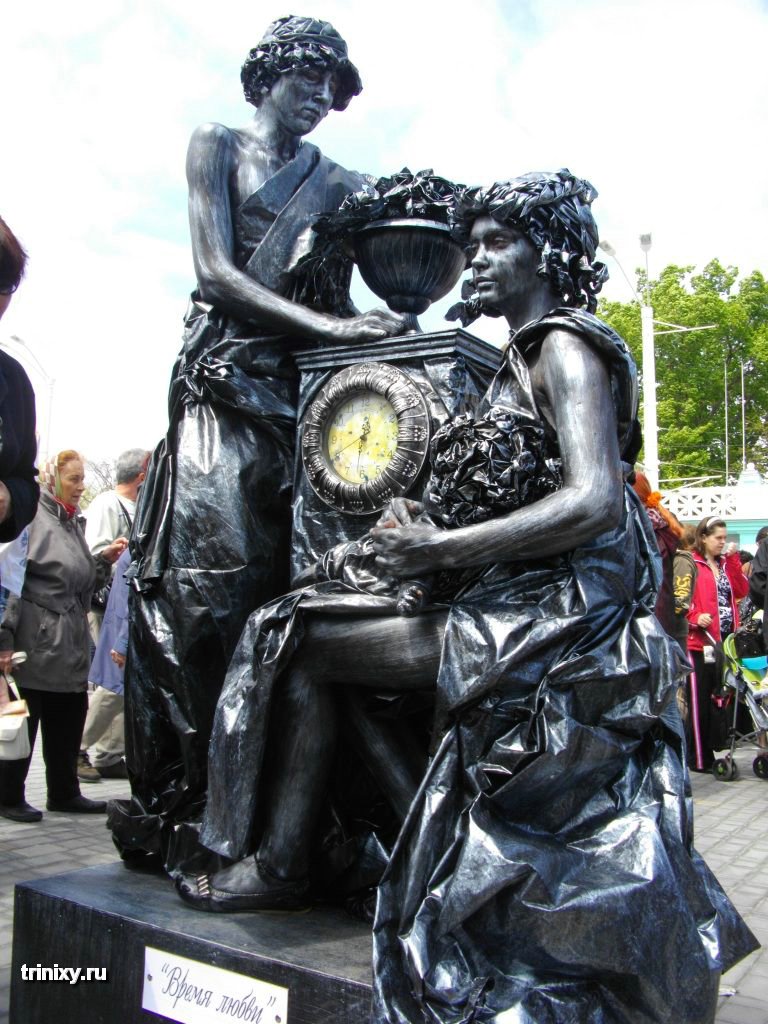
Living statues


In Russia.

Sunday, May 03, 2009

Monopolies

A discussion at the Irish Liberty Forum:

The monopoly concept is seriously misunderstood. Rather than sticking to the classical definition; “an exclusive grant to sell given by government”, some believe that it’s something to do with market share.
[...]
The lesson [of the Standard Oil case]: monopoly has nothing to do with market share as the definition of “market” can be whatever the hell you want it to be.
A month ago, the European Committee on Standards and Interoperability released its report (pdf) into Microsoft's history of anti-competitive behaviour. Its conclusion:
Microsoft’s conduct over the last two decades has demonstrated Microsoft’s willingness and ability to engage in unlawful conduct to protect and extend its core monopolies. This conduct has caused real harm to consumers, who continue to pay high prices and use lower quality products than would have prevailed in a competitive market.
One case looked at was that of DR DOS, a popular rival to MS DOS that was put out of business by Microsoft. When Windows 3.1 was released it had encrypted code hidden away, designed to display a completely false and misleading error message if anyone tried to install it on top of DR DOS. In a memo, Phillip Barrett, a senior Microsoft employee, explained the strategy:
The approach we will take is to detect dr [DOS] 6 and refuse to load. The error message should be something like ‘Invalid device driver interface.
By the mid 1990s DR DOS was effectively out of business, bought up by Novell and used for the boot partition of their servers. In 2000 the damages suit finally came to court, with DR DOS now represented by its new owners, Caldera. In an out of court settlement, made after Caldera's lawyers showed their evidence in preliminary hearings, Microsoft paid an undisclosed sum to Caldera. Looking at transactions between members of the Canopy Group, Caldera's venture capital provider and, at that time, parent, I reckoned this might have been as much as three quarters of a billion dollars, the BBC said it was "several hundreds of millions of dollars".

Whichever, it was fraction of the profits Microsoft had earned through this deliberate fraud on consumers. It was also a fraction of the potential revenues open to DR DOS throughout the 1990s. Consumers were also robbed of the use of a far more advanced and innovative operating system than MS DOS. I ran a DR DOS machine for a while, out of interest, around 2000 and it boasted UNIX shell-like command history and tab completion, a graphical web browser and a graphical email client - on DOS.

So, does the case of Microsoft suggest there should be governmental action to prevent the formation of commercial monopolies? ECSI say they hope their paper will:
... help developers, consumer groups, and government authorities better to understand Microsoft's history of anticompetitive conduct and to recognise its current and future misconduct at an early stage in order to intervene to prevent Microsoft from using tactics other than competition on the merits.
Nothing would do more to further this idea of competition on merits than the streamlining of legal process, and the reduction of the costs involved. Microsoft were at legal fault under existing legislation but they could drag litigation out for years, all the time financially crippling their opponent with the very tactics being complained of.

No new legislation is suggested by the case of Microsoft, but it does show how our legal system is corrupted by the power a rich litigant wields. An imbalance in wealth between parties in a case is sufficient to deny justice. This is a scandalous reality.

And monopolies? Monopolies are bad. But do they really ever arise without the imposition of inequity by the state, either in the person of a monarch granting exclusive rights to a merchant, or in the form of a legal system that favours the wealthy?

Interference

Last autumn during the American election campaign, Blake Benson was charged with "interference with staff of an educational facility".

Michele Obama visited his High School last autumn to give a speech and Benson, a 17 year old student, turned up wearing a NOBAMA T shirt and carrying a McCain/Palin sign.

And that's it. That's what he was arrested for - arrested, handcuffed and taken to one of the school offices by a deputy from the Jefferson County Sheriff's Department. He was also given a one day suspension from his school - suspended for campaigning for the Republican candidate for the Presidency.

The school quickly reversed the suspension. Last Thursday, after more than six months, the Sheriff's Department announced they were dropping the charges.

Albany fraud allegations gain wider audience

My original post on this racked up more than 5,000 reads in two days, after being mentioned by ICECAP and Andrew Bolt. It has just been circulated, together with one from the Scientific Misconduct blog and Doug Keenan's summary, by Benny Peiser's CCNet and reproduced on Watts Up With That.

Friday, May 01, 2009

Locusts

Browsing though YouTube, I came across this version of A Whiter Shade of Pale:


And the most recent comment was this:

Oh does this bring back memories of Pam and my love for her. 40 years later I still love her and only wish I had not had to go into the army, as I lost her then. Not her fault. I told her to go live her life as I might never come back. When I came back I wanted to play for a time and be irresponsible and I did just that. She finished college and got married . We met at our 40th class reunion last summer and our eyes told us both that we were still madly in love. We both departed with sad eyes.
There are the eyes we all have, the same ones we had as teenagers looking at taut skin on our hands, now looking at the liver spots and wondering where did those years go, the ones that the locusts ate.